
Industries
Airport Cleaning for Terminals, Offices and Cargo Buildings
Airport cleaning for passenger terminals, concourses, administration offices and cargo buildings in Northern California and the Reno area, planned around the airport operator’s security rules and flight times.
Cleaning the buildings that keep an airport running
Sage Commercial Cleaning cleans airport buildings: passenger terminals and concourses, administration offices, and cargo and support buildings. The airport operator’s security program decides where and when crews may work, and the plan is built inside it.
Airport operations and facility managers, and terminal tenants who manage their own space, get a written plan for each building, with security rules, airfield trash and flight times built into the schedule.
What a plan covers, by building
| Building or area | Typical work | When it happens |
|---|---|---|
| Ticketing, baggage claim and entrances | Floors, glass at doors, seating, trash and recycling, restrooms | Overnight, with daytime restroom and trash rounds |
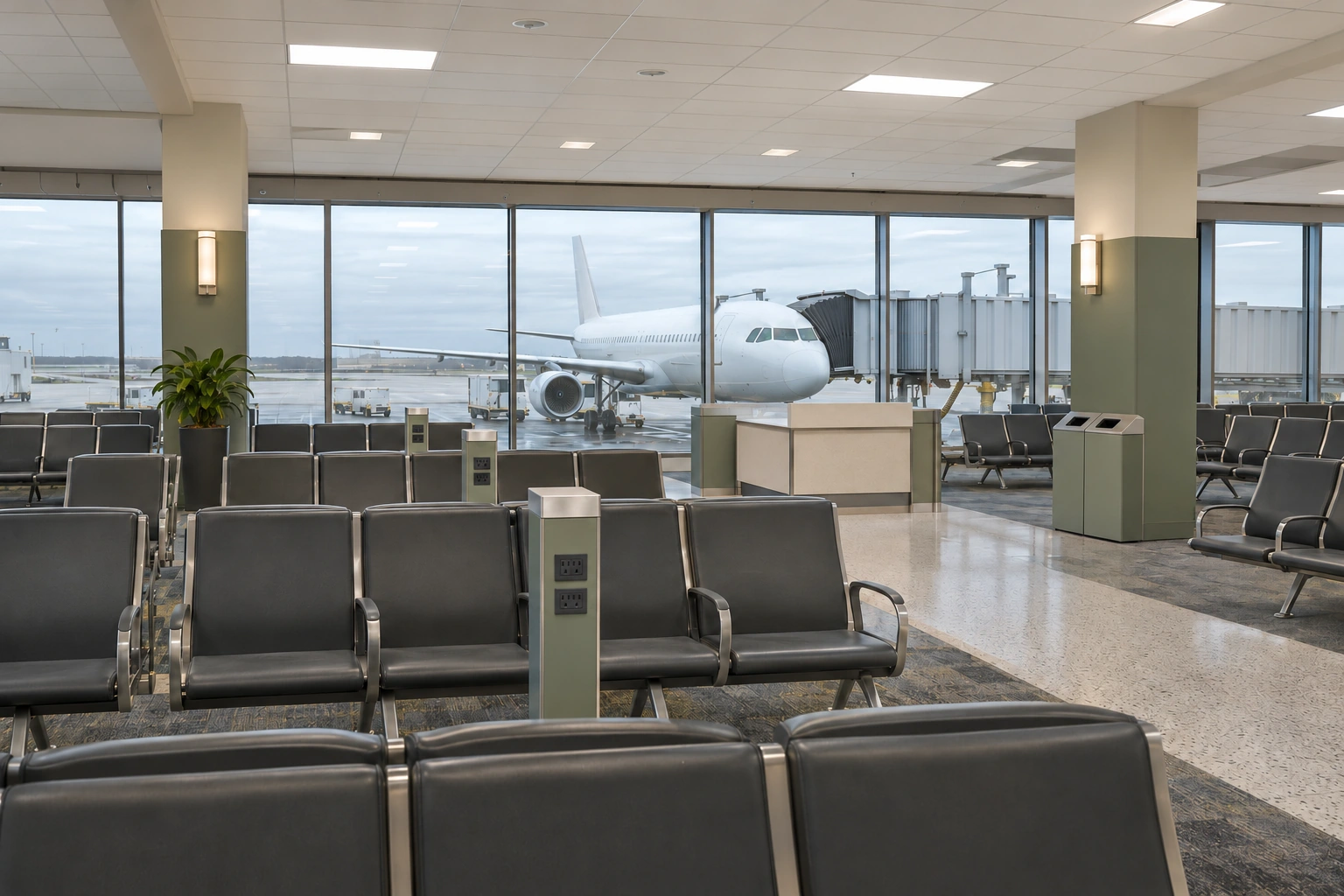
| Concourses and gate areas | Seating rows, carpet and hard floors, drinking fountains, restrooms, trash | Between flight banks and overnight, inside the airport’s access rules |
| Administration and operations offices | Desks, conference rooms, kitchens, restrooms and floors | Nightly or on a weekly schedule |
| Cargo and support buildings | Offices, break rooms, restrooms, locker rooms and warehouse floors | Between or after shifts |
| Service animal relief areas | Waste removal and surface cleaning as the airport assigns | On the airport’s set rounds |
Concourse and terminal floors go on a scrubbing and refinishing cycle through commercial floor care, and carpeted gate areas through commercial carpet cleaning. Cargo buildings with warehouse floors and docks share the methods on our industrial and warehouse cleaning page.
How airport security shapes the work
Every airport that serves aircraft operators with TSA security programs runs under TSA’s airport security rules (49 CFR part 1542), and each one names an Airport Security Coordinator. The airport’s own security program draws the lines for its secured area, air operations area (AOA), security identification display area (SIDA) and sterile area, so the map is different at every field.
Before anyone gets unescorted access to a SIDA, the airport operator must confirm a fingerprint-based criminal history check and complete security training covering badge display, escort and challenge procedures. In a secured area or SIDA, an airport ID stays visible on the outer garment above the waist, or the person is under escort by someone with unescorted access authority.
The airport operator issues those badges and decides who is escorted. Sage background-checks every cleaner, sends names and paperwork the way the airport’s badging office asks, and builds the schedule around the access the airport grants. Restricted doors are never propped or held for anyone, because the rules bar getting around any airport security measure.
Each airport sets its own rules
Each airport publishes its own rules on who needs airport-issued ID, how long a badge lasts and when security training is given. Crews learn the rulebook of the airport they work at before the first shift.
Escorted crews stay in sight of their escort for the whole visit, and every access-controlled door is checked to close fully behind them, even on windy days. A cleaning plan for any airport starts with that airport’s own rulebook.
Keeping terminal trash off the airfield
Trash that escapes a terminal can become foreign object debris (FOD), which the FAA defines as any object in the wrong place in the airport environment that could injure people or damage aircraft. The FAA’s FOD advisory circular (AC 150/5210-24A) names cabin cleaning, waste disposal and other contractors among the people with a role in prevention.
The items it lists are what a terminal throws away every hour: paper, plastic, soda cans, pens, luggage tags and catering supplies. Wind carries light debris from aprons and ramps onto the airfield. Crews tie off liners before bins are full, keep carts covered when waste moves outside, and clean as they go before, during and after each shift, the habit the circular calls clean-as-you-go.
Where an airport requires waste moved within the AOA to be secured and covered, crews do exactly that, and nobody steps into the movement area to chase blown debris. Crews follow whatever the airport sets.
Restrooms and accessible features stay usable
Federal ADA rules require public entities and public accommodations to keep accessible features in working order, while allowing short interruptions for maintenance. Airports with 10,000 or more annual boardings must also provide at least one wheelchair-accessible service animal relief area in each terminal.
Crews clean restrooms in sections where the layout allows, so an accessible stall stays open, and carts and wet-floor zones are cleared from accessible routes as soon as each task is done. Periodic restroom deep cleaning takes care of partitions, fixtures and hard-to-reach corners on top of the daily rounds, and paper, soap and liners can come straight from our janitorial supplies.
Airport cleaning across our service area
We clean airport terminals, offices and cargo buildings across our service area, including San Francisco, San Jose, Oakland, Sacramento, Reno and Fresno.
Working around flights and shifts
Terminal work follows the flight schedule. Heavy tasks such as floor scrubbing, carpet extraction and restroom deep cleaning move to the quiet overnight hours, while restroom checks, trash runs and spill response run through the day. A day porter can stay in the terminal through the morning and evening departure peaks. Office and cargo buildings keep their own nightly or between-shift routine.
Every crew member is background-checked, and Sage is insured and bonded, carries workers’ compensation and provides a certificate of insurance for your vendor file. Supervisors inspect terminal areas against the written task list.
Request airport cleaning pricing
Pricing reflects terminal and office square footage, the number of restrooms, the hours of daytime porter coverage, floor and carpet cycles, and the time badging and escorts add to each shift. Share your task list and the airport’s access rules, walk the buildings with us, and you get a written quote broken down by building and frequency. Hangars on the field are covered on our aircraft hangar cleaning page. Request a quote.
Common questions
Can Sage get airport badges for its cleaners?
The airport operator issues badges and sets the steps. Sage background-checks every cleaner and sends names and paperwork the way the airport’s badging office asks.
Which parts of a terminal can a cleaning crew work in?
The parts the airport operator allows under its security program. Crews without unescorted access work under escort by an authorized badge holder in secured areas.
What do crews do with trash near the ramp?
Liners are tied off, carts stay covered and bins are emptied before they overfill, so wind cannot carry paper or plastic onto areas aircraft use.
Do you supply the paper and soap for terminal restrooms?
Yes. Sage can supply toilet paper, paper towels, hand soap and can liners, and crews restock them on every round.
Can a porter stay in the terminal during the morning departure rush?
Yes. A day porter can cover restroom checks, trash runs and spills through your peak hours, with overnight crews doing the heavier work.